
- October 19, 2026
- By Nic Taylor
- Blog
By Nic Taylor, Master Electrician, ZAP Industries (formerly ZAP Electric), Dickinson, ND
It’s 8 degrees out, the wind is coming across the prairie, and you walk out to the shop to work on a project. Your breath shows, the tools are ice cold, and the concrete feels like a skating rink. A heater that’s too small never catches up. One that’s too big wastes money and may need a much bigger electrical upgrade than you planned. Here’s how to size a garage or shop heater for western North Dakota and what the electrical side takes.
Start with the numbers
Heaters are rated in watts (electric) or BTU per hour. One watt makes about 3.4 BTU per hour, so a 5,000-watt heater puts out roughly 17,000 BTU. Here is a simple rule for electric heaters:
- Well insulated, 8-foot ceiling: about 10 watts per square foot.
- Some insulation, or a 10-foot ceiling: about 12–15 watts per square foot.
- Uninsulated metal building, or doors that get opened a lot: about 20 watts per square foot, and sometimes more.
So a two-car garage of 24 x 24 feet (576 sq ft), insulated, wants about 5,800 watts. The same garage with no insulation could want 10,000 or more. Heating is easiest when the building is tight, so insulating the walls and ceiling and sealing the overhead door often saves you more than a bigger heater does.
What changes the answer in North Dakota
- Insulation. This is the biggest factor. An uninsulated steel shop leaks heat as fast as you add it.
- Ceiling height. Every extra foot adds air to heat. A 12-foot shop needs noticeably more heater than an 8-foot garage.
- How you use it. Keeping a garage at 50°F for a project is easier than holding 68°F for all-day work. You can also heat it on demand and warm up the space before you go out.
- Overhead doors. Each time you open one at 10 below, a lot of heat goes out. Insulated doors with good seals help a lot.
- Slab. A cold concrete floor takes a long time to warm up, so heat comes up slowly the first day.
For a quick estimate, use our free garage heater calculator. Enter your size and insulation, and it gives you a recommendation.
Electric or gas?
Electric heaters are the simplest to install. There’s no venting, no gas line, and no combustion air. They run quietly and don’t create moisture or fumes, which is good for a shop with paint, finishes or a vehicle. The cost is the power bill, and the circuit has to be sized correctly.
Natural gas or propane unit heaters cost less to run per BTU, especially for big shops. They need a gas line or tank, a vent to the outside, and a fresh air supply, and they take a bigger install. For a larger shop or one that’s used all winter, gas can make sense. For a typical home garage, a hardwired 240-volt electric heater is usually the easier choice.
Voltage, amps, breaker and wire
Most garage heaters from 3,000 watts up run on 240 volts. They are hardwired, not plugged in, and need their own dedicated circuit. A heater runs for hours at a time, so the code treats it as a continuous load. The circuit has to be sized with extra room, around 125% of the heater’s draw. Here is what that looks like at 240 volts, with copper wire:
| Heater size | Amps | Breaker | Copper wire |
|---|---|---|---|
| 5,000 W | 20.8 A | 30 A, 2-pole | 10 AWG |
| 7,500 W | 31.3 A | 40 A, 2-pole | 8 AWG |
| 10,000 W | 41.7 A | 60 A, 2-pole | 6 AWG |
| 15,000 W | 62.5 A | 80 A, 2-pole | 4 AWG |
The heater’s installation sheet gives the exact breaker and wire size, and long runs may need larger wire. Do not put a 5,000-watt heater on 12-gauge wire, even if the breaker “fits.”
The other question is whether your panel has room. A 10,000-watt heater adds about 42 amps to your service. If you also have an EV charger, a dryer, and an electric range, we may need to do a load calculation to see if your panel can handle it. That’s the step people skip, and it’s the reason a heater install sometimes turns into a panel upgrade.
All of this work needs a permit and inspection in North Dakota and should be done by a licensed electrician.
A quick way to choose
- Measure the floor area and ceiling height.
- Pick your insulation level and use the watts per square foot above.
- Round up to the next heater size, not down.
- Check the breaker and wire size against the table.
- Confirm your panel has the capacity.
Get a heater sized and installed
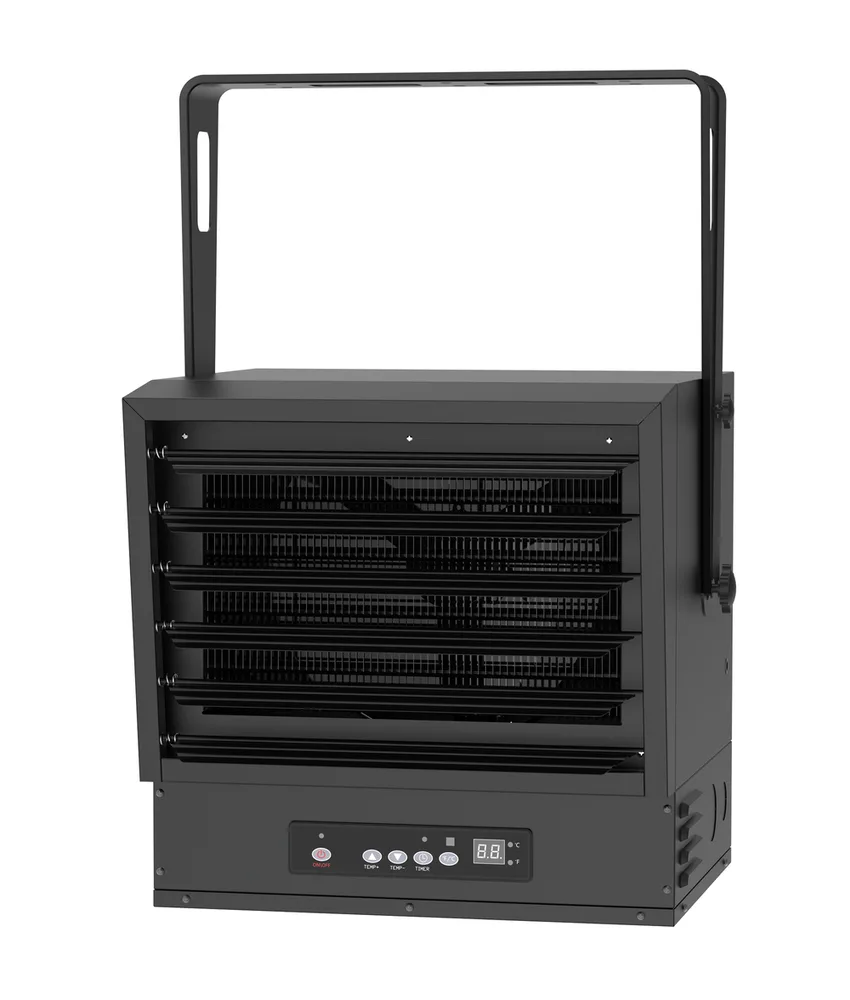
You can compare 240-volt electric garage heaters in sizes from about 5 kW to 15 kW in our Garage Heaters shop. Or use the heater calculator and let us handle the rest. We’ll check your panel, run the circuit, mount the heater and set the thermostat.
ZAP Industries is a licensed North Dakota electrical contractor (License #000047000) based in Dickinson. We take calls 24/7 and offer weekend emergency service.
Call (701) 513-9012 or email ntaylor@zapelectric.llc and we’ll size the right heater for your shop before the next cold snap.